Aerobic Threshold: The Missing Piece in Your Running Training.
Want to become a faster, more efficient runner? Building a strong aerobic base is the key to unlocking better endurance, improving running efficiency and getting more out of every session.
When runners think about getting faster, they often focus on intervals, threshold workouts and VO₂ max sessions. While these all have a place in a well-designed training program, one of the biggest opportunities for improvement lies in developing the aerobic system that supports everything else.
Aerobic threshold (AeT), also known as LT1, helps us understand how hard we can run while maintaining a predominantly aerobic effort. Improving your aerobic capacity allows you to run faster at a lower relative effort, manage fatigue more effectively and maintain your pace for longer.
What is aerobic threshold?
Aerobic threshold is the intensity at which the body's response to exercise begins to change noticeably as exercise intensity increases. Below this point, the body can sustain a predominantly aerobic effort with relatively low metabolic disturbance. As intensity increases above this threshold, lactate and other metabolic responses begin to rise more noticeably, although the exact transition varies between individuals.
It's important not to confuse aerobic threshold (LT1) with anaerobic threshold (LT2). LT1 represents a lower intensity boundary, while LT2 occurs at a substantially higher effort and is more closely associated with sustained hard running. Both matter, but they serve different purposes in training.
Why is aerobic threshold important for runners?
1. Run faster at the same effort
A well-developed aerobic system allows you to produce more speed for a given heart rate and perceived effort. It allows you to run at a purely aerobic effort without accumulating lactate or undue fatigue. Over time, by increasing your aerobic threshold, an easy run that once required 5:00/km might become 4:40/km at a similar physiological cost.
2. Build endurance without accumulating excessive fatigue
Volume is king. Easy running should help you absorb training, not leave you needing several days to recover. Training at an appropriate aerobic intensity allows you to accumulate consistent volume while managing the fatigue that can compromise harder sessions.
3. Improve your ability to sustain pace
A stronger aerobic system supports glycogen sparing, fat oxidation and the ability to maintain a steady effort over longer distances. These adaptations are particularly valuable for half-marathon, marathon and ultra-distance runners.
4. Make your training more individualised
Heart-rate zones calculated from age or generic percentages are only estimates. Testing your own response to sustained exercise gives you a more useful starting point for setting training intensities.
How do you test aerobic threshold?
There isn't one perfect field test that identifies LT1 with absolute precision. However, a controlled 60-minute aerobic run can provide useful information when pace, heart rate, terrain and conditions are considered together.
One useful measure is heart-rate drift — how much heart rate rises over time when running at a relatively consistent pace, or how pace changes when heart rate is held steady. A large increase in heart rate at a constant pace can indicate that the effort is becoming harder to sustain aerobically ie. you are not fit enough for that pace and that duration. However, heat, hydration, fatigue, hills and other factors also influence drift, so it shouldn't be interpreted in isolation.
Laboratory testing using blood lactate measurements or ventilatory analysis can help identify LT1 more directly. Field testing is a practical alternative for monitoring trends over time.
My own aerobic threshold testing: two runs, one week apart.
As an Exercise Physiologist and running coach, I apply the same principles to my own training that I use when helping athletes understand their own physiology.
This week, I repeated a 60-minute aerobic run to compare the results with the previous week's session.
The results
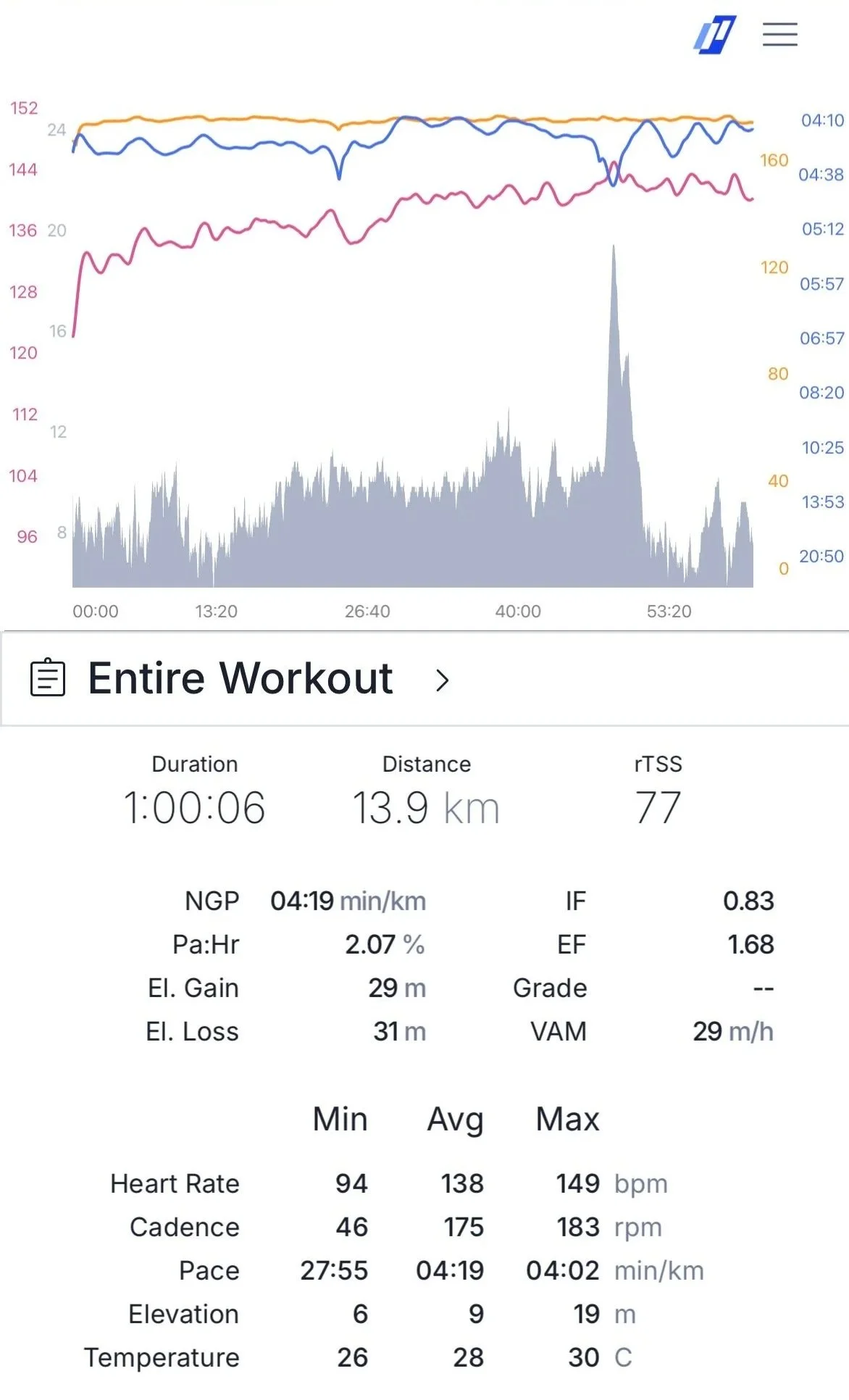
17/10/2026
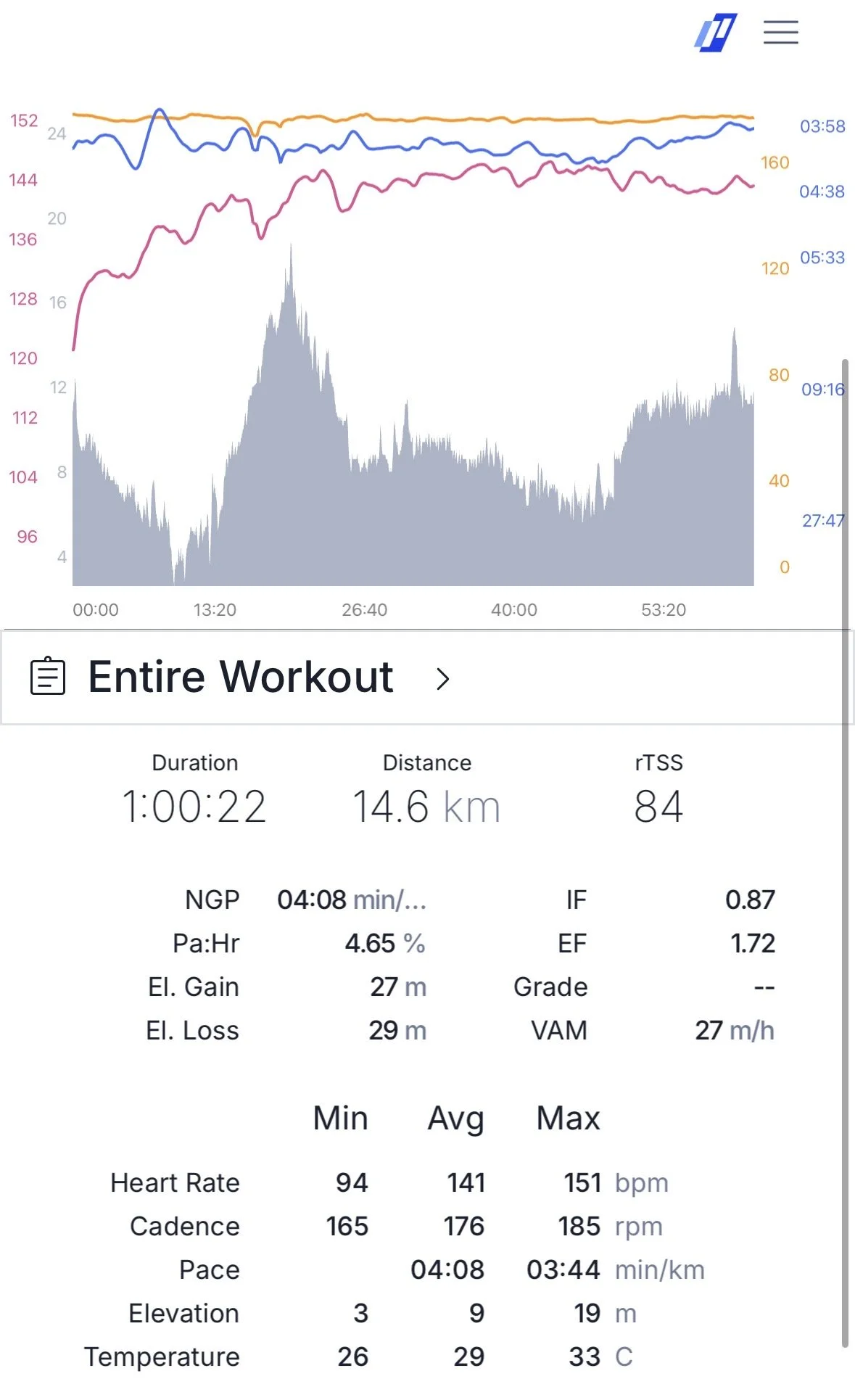
24/10/2026
What do these results tell us?
1. I ran approximately 10s/km faster.
The second run covered around 670 metres more distance in a similar duration, with an average heart rate only about 3 beats higher. That's an encouraging difference in pace relative to heart rate..
2. Heart-rate drift was within range.
On both runs, heart rate increased by approximately 6 beats per minute from the first half to the second half. Importantly, the pace remained relatively consistent rather than deteriorating substantially. In week 1 HR drift was quite low, so on week 2 I deliberately increased the effort, aiming to find the upper limit of my aerobic threshold HR. The results suggests I was able to sustain both efforts reasonably well, although the results alone cannot confirm my exact LT1.
3. My current working aerobic threshold is around 145 bpm.
Based on the second run, and my broader training data, approximately 145–148 bpm is a reasonable working estimate for my aerobic threshold HR. This is an estimate, not a definitive physiological measurement. The key lesson is that I am not simply looking for a particular pace or heart rate. I am looking at the relationship between the two (Pa:HR), how stable that relationship remains over time and how my body responds to the training load.
What should you aim for?
There is no universal aerobic aerobic threshold heart rate or ideal pace. Two runners of the same age can have very different thresholds, and a pace that is genuinely easy for one athlete may be too demanding for another. It is determined by many factors but mainly related to training history.
When assessing an athlete, I look at several factors:
Heart rate: Does it remain reasonably stable as the session progresses?
Pace: Can the athlete maintain their speed without increasing effort excessively?
Perceived exertion: Does the run feel controlled and conversational?
Conditions: Are heat, humidity, terrain or hydration affecting the data?
Consistency: Do repeat tests show similar results, or a meaningful change over several weeks?
For a controlled field test, low heart-rate drift is generally encouraging ie. < 5%.. The goal is to establish an individual baseline, then track whether the athlete can run faster at the same heart rate, maintain a lower heart rate at the same pace, or sustain the effort more comfortably. This is how we know you are getting fitter and building a strong aerobic base.
How can coaching help?
Understanding your aerobic threshold is only one part of the picture. The real value comes from using that information to guide your training.
At A+ Health & Performance, I use an evidence-based approach to running and endurance coaching, combining individualised training zones, structured sessions, strength training and ongoing performance analysis.
Whether you're preparing for your first half-marathon, chasing a marathon PB or building towards an ultra, your training should reflect your current fitness, goals and ability to recover.
Rather than guessing your easy pace or relying solely on generic heart-rate zones, we can assess your training data, establish appropriate intensities and monitor your progress over time.
Want to understand your training better and become a more efficient runner?
Get in touch with me to discuss personalised running coaching and a training program built around your goals.